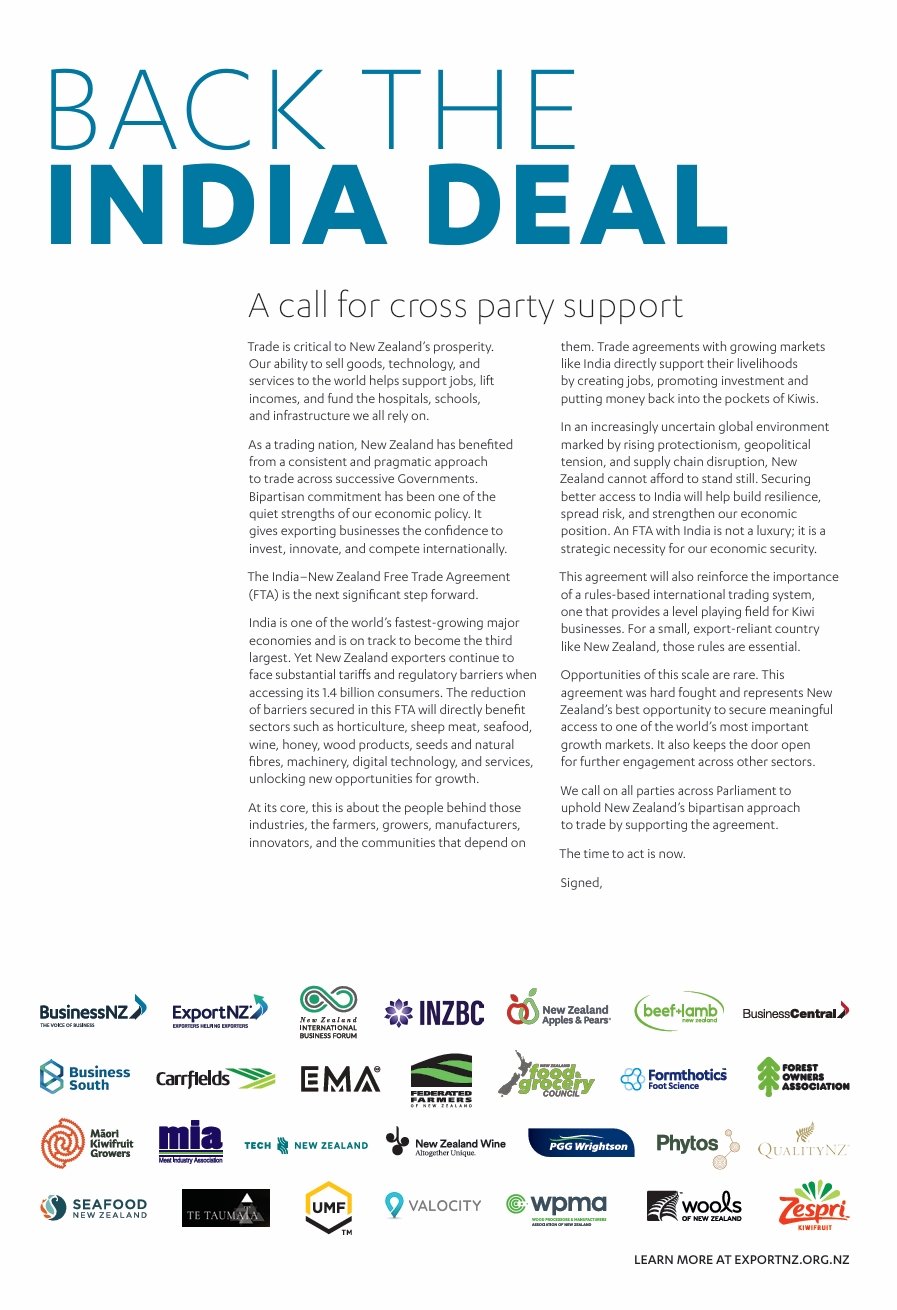
NZIBF welcomes conclusion of negotiations on New Zealand–India Free Trade Agreement
Press Release: NZIBF welcomes conclusion of negotiations on New Zealand–India Free Trade Agreement
The New Zealand International Business Forum (NZIBF) today welcomed the conclusion of negotiations on the New Zealand–India Free Trade Agreement, describing it as important progress towards strengthening economic ties with one of the world’s fastest-growing major economies.
NZIBF Executive Director Felicity Roxburgh said the agreement reflected the significant commitment and sustained investment by the governments on both sides. “We congratulate the leaders of India and New Zealand for their vision and sustained engagement in reaching this outcome,” Ms Roxburgh said.
The agreement will improve trade conditions and advance shared interests across multiple sectors of the economic relationship. However, NZIBF is disappointed that the deal has not delivered comparable improvements for the dairy sector.
“The conclusion of negotiations marks a beginning, not an end,” Ms Roxburgh said. “This agreement provides a platform on which New Zealand and India can continue to grow trade, investment, and innovation partnerships.” The NZIBF noted the business community would need to work together with government to take advantage of new opportunities.
A strategic opportunity during a time of global volatility
NZIBF noted that the agreement represents an investment in a long-term strategic partnership grounded in transparency, predictability, and clear rules for doing business.
“This agreement provides new economic architecture that will give many New Zealand exporters greater optionality in a period of global geopolitical and trade policy uncertainty,” Ms Roxburgh said. “Concluding an agreement reinforces the value of the international rules-based framework that provides certainty for firms making long-term investment and market-entry decisions.”
NZIBF said the agreement will support expanded collaboration in services, digital trade, innovation, food and fibre, and sustainable growth—areas where both economies have strong complementary advantages. The agreement also provides a platform to continue pursuing remaining areas of bilateral economic potential. It will be important that ongoing engagement continues to address the remaining “unfinished business” in dairy.
Years in the making
Ms Roxburgh said the outcome reflects many years of sustained investment and commitment by successive governments in New Zealand and India, recognising the long-term strategic importance of a broad relationship. She acknowledged the perseverance and professionalism of the trade negotiating team operating under the tireless leadership of Minister of Trade and Investment Hon Todd McClay. “These efforts have helped unlock a strategic opportunity for many New Zealand exporters at a time when diversification and economic resilience matter more than ever,” she said.
NZIBF further recognised the vital role played by New Zealand’s business community and the Indian diaspora, who have consistently advocated for deeper commercial ties and strengthened people-to-people connections over many years. Their efforts have also shaped substantive platforms for advancing the bilateral relationship, including the kiwifruit industry’s long-standing proposal for agricultural cooperation between New Zealand and Indian growers — an initiative that has now been reflected in the FTA through improved market access.
New Zealand industry is enthusiastic about deepening agricultural cooperation with Indian partners, particularly in horticulture, and stands ready to share expertise, support innovation, and help drive higher production and stronger returns.
Positive progress for many exporters – but dairy remains a missed opportunity
The Forum welcomed improved outcomes for sectors including kiwifruit, lamb, horticulture, forestry and wine, reflecting commercially meaningful gains for many NZIBF members. The Forum was also pleased to see a chapter supporting Māori business linkages across culture, trade, traditional knowledge and rongoā Māori (traditional medicine), recognising India as an important market for key Māori economic sectors.
However, NZIBF expressed disappointment that the agreement does not deliver any significant new access for core dairy, although this is not surprising given India’s longstanding sensitivities around its domestic dairy market.
“Dairy is New Zealand’s largest goods export and India represents one of the world’s most significant emerging consumer markets,” Ms Roxburgh said.
NZIBF emphasised that dairy should remain a priority area for continued dialogue and future improvement.
A foundation to build on
NZIBF will work closely with government, industry partners, and Indian counterparts to ensure the agreement delivers practical, on-the-ground benefits for exporters once it enters into force.
“While this is a step-forward for many exporters, the real work starts now,” said Ms Roxburgh.
The NZIBF is also ready to work with the New Zealand Government on a proactive, dairy-specific strategy to address rising non-tariff barriers and explore further tariff reductions, with the goal of improving market optionality for the dairy sector in an increasingly volatile global trade environment.
ENDS