
Submission to the Foreign Affairs Defence and Trade Parliamentary Select Committee on the New Zealand-India FTA
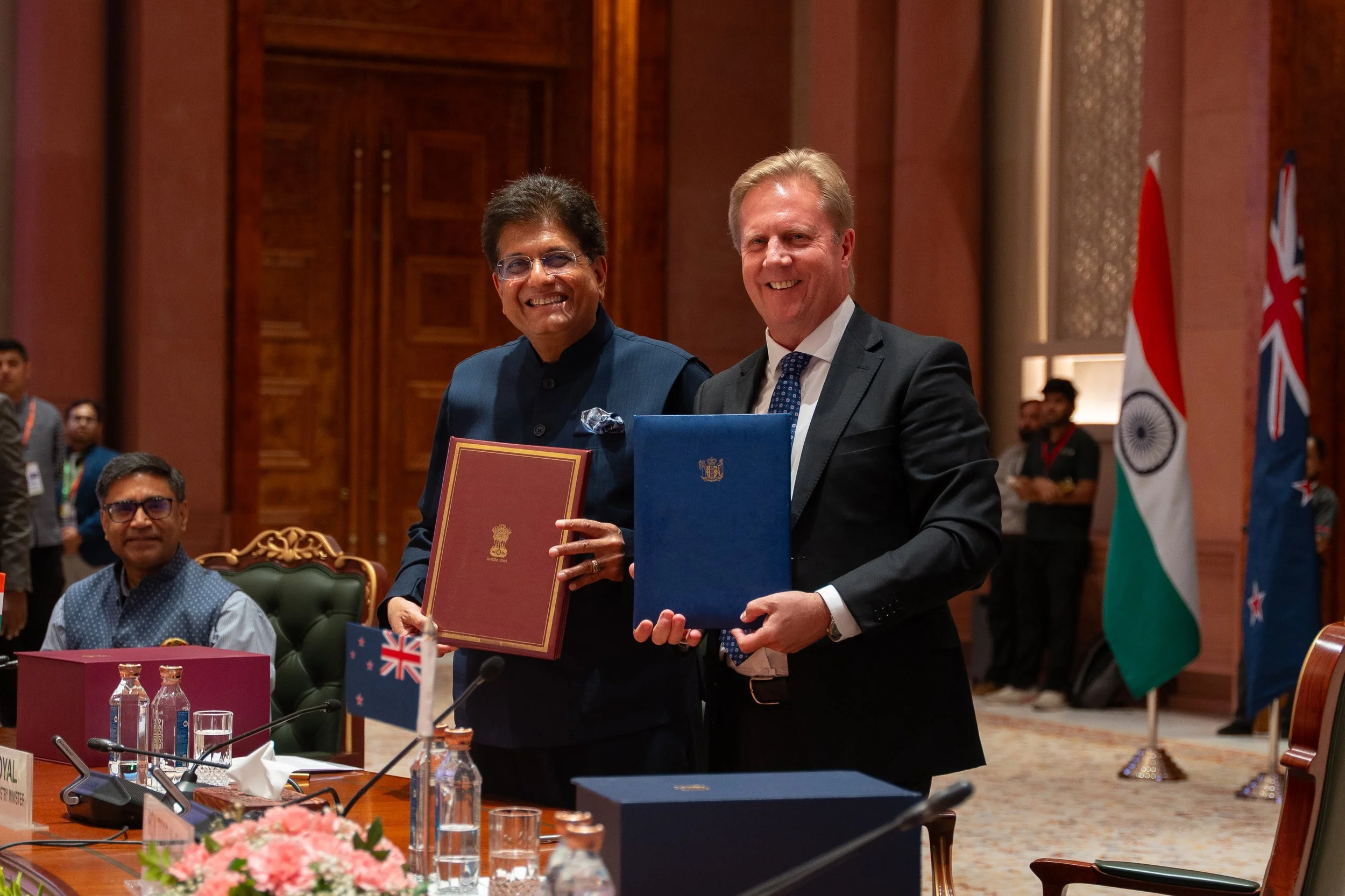
New Zealand Minister of Trade and Investment Hon Todd McClay and Indian Minister of Commerce and Industry Piyush Goyal: Photo Credit Beehive.govt.nz
NZIBF Submission to the Foreign Affairs, Defence, and Trade Parliamentary Select Committee on the International Treaty Examination of the Free Trade Agreement between the Government of New Zealand and the Government of India
17 May 2026
Introduction
This submission is made on behalf of the New Zealand International Business Forum (NZIBF). NZIBF brings together leading exporters and business organisations to promote sustainable open trade.
Executive Summary
NZIBF welcomes and strongly supports the Free Trade Agreement (FTA) between New Zealand and India (the Agreement). We consider the Agreement to be commercially meaningful and capable of delivering significant mutual benefit to both countries. Since the conclusion of negotiations, NZIBF has consistently supported the Agreement as an important step in deepening economic ties with one of the world’s fastest-growing major economies.
Trade underpins New Zealand’s prosperity, and this FTA delivers meaningful commercial gains across several of New Zealand’s key export sectors. It will unlock new opportunities for growth while establishing a platform for future expansion of market access.
In an increasingly uncertain global environment marked by rising protectionism, geopolitical tension, and supply chain disruption, New Zealand exporters face growing challenges. Securing improved access to India will help build resilience, diversify risk, and strengthen New Zealand’s economic position.
NZIBF considers that the Agreement also reinforces the importance of a rules-based international trading system, which is essential for a small, export-reliant country such as New Zealand. Free Trade Agreements are a critical tool for providing exporters with greater certainty, predictability, and a more level playing field in international markets.
India is one of the world’s fastest-growing major economies and is projected to become the world’s third largest economy. Despite this, New Zealand exporters have continued to face significant tariffs and regulatory barriers in accessing its 1.4 billion consumers. The FTA will reduce many of these barriers, creating new opportunities across sectors including horticulture, sheep-meat, seafood, wine, honey, wood products, machinery, digital technology, and services.
NZIBF welcomes the inclusion of most-favoured-nation provisions for wine and services. These provisions are particularly important in a competitive global environment, helping ensure New Zealand exporters are not disadvantaged as India negotiates agreements with other trading partners. NZIBF also emphasises the importance of timely ratification so exporters can realise the benefits of early entry into force.
India’s growing population, rising disposable incomes, and increasing demand for higher-quality food and consumer products make it an attractive long-term export destination for New Zealand businesses. The Indian market is of significant interest to the sectors and companies represented within NZIBF’s membership.
While it is disappointing that the FTA does not deliver substantial new dairy market access at this stage, NZIBF acknowledges the realities of the negotiating environment and supports the Agreement as an important foundation for the broader bilateral relationship. The Agreement creates a platform for deeper engagement over time and preserves the opportunity for future liberalisation as the relationship continues to mature. It is important that the review mechanisms in the FTA are fully utilised to achieve a levelling-up in the future for dairy with the level of trade liberalisation now enjoyed by other sectors, both in India and elsewhere.
The FTA should also be viewed as part of a broader strategy to strengthen New Zealand’s relationship with India. NZIBF strongly supports the continued development of a national strategy to deepen engagement across areas including science and technology, education, investment, and people-to-people links.
NZIBF recommends that the Select Committee report to Parliament that the FTA represents a highly positive outcome for New Zealand and should be enacted through legislation as a matter of urgency.
About the NZ International Business Forum (NZIBF)
NZIBF provides a voice to articulate the needs and priorities of New Zealand’s international business community, and particularly the importance of open markets, to the New Zealand Government and public stakeholders. The NZIBF Board brings together leaders from among New Zealand’s largest internationally oriented companies and peak business organisations representing major sectors of the New Zealand economy and more than $50 billion in exports.
The case for increased trade with India
India is emerging as an economic super-power and this FTA is of genuine strategic significance for New Zealand. India's economic growth is expected to remain robust over the next five years, with estimates that the annual growth rate will be about 6.5 to 7 per cent over that period. IMF data suggests India is likely to overtake Japan’s economy in 2025 and Germany’s in 2027, giving it the third-largest GDP in the world.[1] India’s geo-strategic significance is growing in accordance with its economic development.
Despite India’s rapid growth, bilateral trade is significantly lower than what it could be. Over the past five years, New Zealand's exports to India have been on a downward trend. In 2018 goods exports were valued at NZ$ 1.04 billion, but this figure has since declined, with exports in calendar year 2024 valued at NZ$ 718 million, representing an annualised decrease of about 12 percent. Key factors influencing this trend include prohibitive tariff levels, issues related to India’s log treatment regime, as well as global trade dynamics. New Zealand ranks only 83rd amongst India’s 220 export markets.[2]
Despite New Zealand’s obvious strengths in food and beverage, F&B exports in calendar year 2024 accounted for only about 14 per cent (NZ$ 99 million) of New Zealand’s total goods exports to India (NZ$718 million). With better market access there are significant prospects for New Zealand to meet India’s increasing need for high quality food. NZTE notes that India’s food and beverage sector is expected to grow by 7 per cent over the next five years.[3]
By contrast, Indian exports to New Zealand have grown significantly during the last ten years, doubling from $0.58 billion in 2015 to $1.17 billion in calendar year 2024. This growth has been driven by rising demand for products like mineral fuels, electronics, and textiles.
New Zealand exporters are operating in an increasingly complex and uncertain global environment, marked by intensifying geopolitical pressures and evolving regulatory settings. As the Government has noted, the international system that New Zealand has long relied on is under strain, with growing protectionism and an increased focus by major powers on economic security. In this setting, agreements like the India deal are an important tool to expand market access in key markets and create options for firms.
Specific issues addressed in the negotiation
NZIBF is pleased that the FTA is of high quality and ambitious and conforms to Article XXIV (8) (b) of the WTO’s General Agreement on Tariffs and Trade, which stipulates that FTAs should cover “substantially all trade” of the participating countries.
Dairy
NZIBF has consistently recognised the political and economic sensitivity of the dairy sector in India, while also highlighting the long-term complementarities between New Zealand and Indian dairy markets. New Zealand’s dairy sector has the capacity to support India’s growing demand for high-quality dairy ingredients and specialised products in a way that complements domestic production and contributes to food manufacturing and economic growth in India.
While the New Zealand - India FTA delivers only limited market access outcomes for dairy at this stage, NZIBF supports the Agreement as an important strategic step forward for the New Zealand economy. However, improved access to the Indian dairy market will remain a long-term priority for New Zealand’s dairy sector. In this context, NZIBF considers it important that the Agreement’s review mechanisms give priority to upgrading the dairy outcomes
It is positive that alongside a commitment to review the FTA one year after entering into force India has committed that should it offer dairy access to comparable countries in the future, it will consult with New Zealand on the prospect of extending similar treatment to us.
Dairy has a demonstrated ability to grow export revenue at a scale unmatched elsewhere in the New Zealand economy and building further market options for the dairy industry will support economic growth for New Zealand.
Red meat
During negotiations, NZIBF strongly advocated for market access outcomes for sheep-meat exports, noting that India’s high tariffs had constrained growth opportunities in what remains a highly price-sensitive market. The market offers great potential as an attractive export destination for the New Zealand red meat sector.
The Agreement delivers substantial tariff reductions across a wide range of red meat and co-product exports, including sheep-meat, hides and skins, blood products, meat and bone meal, and prepared meat products, creating potential cost savings and opening new opportunities for future trade growth in the Indian market. The FTA’s outcomes will improve New Zealand’s competitive position in the Indian market and represent a positive step toward building greater commercial presence over time. While growth may initially be gradual, the Agreement creates a stronger framework for exporters to invest in the market with greater certainty.
In addition to unlocking a promising market that has been constrained due to the 33 percent tariff on sheep-meat, the FTA will deliver important additional options for our red meat exporters, spread risk and provide greater stability.
As well as tariff reductions, the FTA also provides for formal avenues to address and resolve non-tariff barriers and facilitate trade. Among the NTBs faced by the red meat industry are prohibitive regulatory requirements, and excessively prescriptive animal health requirements. The FTA provides a formal platform for addressing and resolving these issues.
Horticulture
During negotiations, NZIBF welcomed efforts to strengthen horticultural cooperation and advocated tariff reductions for products such as apples, pears and kiwifruit, where Indian demand has shown strong long-term growth. The sector has significant potential given complementary growing seasons, rising consumer awareness of health and nutrition, and increasing demand for premium imported produce.
The FTA and associated horticultural cooperation arrangements represent a successful outcome that will support deeper technical collaboration and long-term market development. The Agreement delivers unprecedented improvements in market access for NZ horticulture, including a world first 50 percent tariff reduction for apples during the counter-seasonal export window and a 50 percent tariff reduction for pears with no quota restrictions, creating significant opportunities for growth in the Indian market over time. It will play a pivotal role in achieving New Zealand Apple and Pears Industry’s ambition of becoming a $2 billion export sector by 2035.[4] The apple and pear outcomes are strategically important, establishing a foundation for sustained growth in a key market.
Access to high-value international markets such as India is crucially important to sustaining the economic footprint of New Zealand’s pip-fruit industry and the employment of more than 13,000 New Zealanders. NZIBF notes that New Zealand was the first nation to secure the inclusion of apples within an FTA with India.
The FTA also delivers a significant breakthrough for the New Zealand kiwifruit industry by substantially improving market access. The Agreement removes tariffs on up to 15,000 tonnes of kiwifruit exports annually and halves tariffs on additional volumes, while also supporting long-term industry collaboration through a Kiwifruit Action Plan focused on grower cooperation, research, production, and supply chain development in India. India presents a major growth opportunity for the New Zealand kiwifruit industry, with improved market supporting growing demand from health-conscious Indian consumers and creating long-term value for growers.[5]
Wine
In the negotiations, NZIBF supported improved tariff treatment for New Zealand wine exporters, recognising that the Indian wine market is still emerging but offers promising long-term potential among increasingly affluent consumers in India’s major cities.
The FTA’s tariff outcomes provide greater certainty and improve the commercial environment for New Zealand wine exporters. Wineries will be able to plan with confidence around a clear, decade-long tariff reduction pathway. While current exports to India are very modest, just under NZ$300,000 (FOB) in 2025 due to the very high tariffs, improved market access under the FTA is expected to make India increasingly attractive to New Zealand wine exporters over the coming years[6]. The inclusion of an Annex on wine, whisky and distilled spirits is welcomed for supporting New Zealand wine exports through improved regulatory protections and the establishment of a dedicated working group to advance cooperation over time.
Given indications that the European Union has potentially secured more favourable wine tariff reductions with India, it is important that the FTA enters into force promptly to help ensure New Zealand wine exporters are not placed at a competitive disadvantage.
Seafood
The FTA achieves duty free access on most seafood exports, including mussels and salmon, over seven years. It also strengthens the overall framework for trade and will improve conditions for exporters over time. While commercial opportunities are likely to emerge gradually, the Agreement helps position New Zealand exporters to participate in the future expansion of India’s imported seafood market.
Forestry and Wood Products
With the Indian wood products market forecast to grow from around USD $1 billion in 2025 to USD $1.47 billion by 2029, alongside economic growth of approximately 8 percent, India is expected to become one of the world’s largest consumers of wood products, holding great potential for New Zealand exporters.
The elimination of tariffs on more than 95 percent of New Zealand timber, lumber, and related exports, including pulp and paperboard, creates substantial opportunities for New Zealand wood processors and manufacturers. Almost all other exports benefit from tariff elimination over seven years, providing further opportunities for wood exporters. The FTA also provides opportunities to grow durable, long-term, and mutually beneficial relationships between Indian and New Zealand forestry sectors [7].
Wool
India is an increasingly important market for New Zealand wool and a major global textile producer. NZIBF recognises the potential for stronger integration between New Zealand wool producers and India’s expanding textile and manufacturing sectors.
India is already an important market for New Zealand wool, importing around NZ$77 million of wool products annually, and this Agreement provides a stronger foundation to expand that relationship over time.[8]
The elimination of tariffs on wool from the Agreement’s entry into force will reduce costs and improve competitiveness for our exporters. The FTA is likely to create significant opportunities for New Zealand’s wool sector by strengthening ties with India’s globally recognised carpet and textile manufacturers and improving the competitiveness of New Zealand wool products in the market.
The Agreement is expected to support increased demand for high-quality New Zealand wool, strengthen value-added manufacturing partnerships, and help position natural fibres as a sustainable alternative to synthetic products.[9]
Education
NZIBF strongly supports efforts to deepen education ties between New Zealand and India, including through more streamlined visa settings, improved student mobility, and stronger institutional cooperation. The value of education to New Zealand’s economic relationship with India is significant and growing. In 2025 10,600 Indian students enrolled in New Zealand educational institutions, up 34 percent on 2023. Education New Zealand (ENZ) has identified India as a key growth market for international student recruitment as part of its strategy to double the value of New Zealand's international education sector to NZ$4.4 billion by 2027.
The Agreement represents a highly positive outcome for the education sector. Improvements in visa processes and government support for educational engagement are helping strengthen people-to-people links and reinforce New Zealand’s position as an attractive destination for Indian students. The Agreement provides Indian students with guaranteed post-study work rights in New Zealand for periods ranging from two to four years, depending on qualification level.
Embedding these settings within a trade Agreement provides greater certainty for education providers recruiting from one of the world’s largest international student markets and strengthens New Zealand’s competitiveness relative to destinations such as Australia, the United Kingdom, and Canada.[10]
Tourism and Air Connectivity
NZIBF welcomes initiatives aimed at improving aviation links and tourism connectivity between New Zealand and India, recognising the importance of direct engagement in strengthening trade, investment, and broader bilateral ties.
The air services arrangements associated with the FTA are a positive development. Enhanced connectivity, including the exploration of direct flights, has the potential to strengthen tourism, business links, and cultural engagement while also supporting the growing Indian diaspora community in New Zealand.
Goods Market Access
The Agreement delivers commercially significant tariff reductions and expanded quotas across many of New Zealand’s key primary goods exports, including sheep-meat, wool, seafood, forestry and wood products, and horticulture. A substantial proportion of existing exports will benefit from either immediate duty-free access or phased tariff reductions.
This new preferential access provided by the FTA will provide valuable new opportunities to grow exports to India, and a more level playing field with competitors from India’s FTA partners who already enjoy low or no tariffs on many of their exports.
The FTA represents a meaningful and commercially significant step forward in strengthening New Zealand’s economic relationship with one of the world’s fastest-growing major economies. The Agreement delivers improved market access across a range of sectors and establishes an important platform for future liberalisation and economic cooperation.
Services, Labour Mobility and Investment
NZIBF supported ambitious services commitments, stronger regulatory cooperation, and improvements to labour mobility arrangements to facilitate business engagement and services exports. NZIBF has long supported stronger two-way investment flows and protections that provide certainty for investors while preserving governments’ right to regulate in the public interest.
The Agreement makes progress in supporting services trade, business mobility and investment. Improved frameworks for engagement, alongside broader regulatory cooperation, should help create additional opportunities for New Zealand firms operating in sectors such as education, technology, and professional services.
The presence of services MFN provisions, which may allow New Zealand to benefit from more favourable terms negotiated by other countries, but only once the agreement is in force, make it important that the Agreement is ratified promptly.
NZIBF does not have concerns regarding the labour mobility provisions contained in the Agreement. New Zealand businesses and exporters benefit from access to global talent where specialist skills and experience are not readily available domestically, and India is an important and growing source of highly skilled professionals. The FTA supports stronger business and people-to-people links while preserving New Zealand’s ability to maintain control over its immigration settings and policy framework.
NZIBF welcomes the strengthened framework that the FTA provides for bilateral investment. The FTA supports closer commercial integration between New Zealand and India including cooperation activities such as trade delegations, workshops, and events to promote two-way investment and build the investment relationship.
The FTA commits the government to promote up to US$20 billion of New Zealand private sector investment in India over 15 years. From our own assessment of the text and assurances from officials, we understand that this is not a binding commitment to reach this target but a carefully crafted obligation for the New Zealand to demonstrate that it is promoting investment into India. We assess that increased confidence and engagement between businesses in both countries should support further investment opportunities over time, albeit likely at lower levels than the text commits the government to promote
Digital Trade and Paperless Trade
The FTA makes modest but constructive progress in supporting digital trade cooperation and modern trade facilitation practices across the Agreement. While implementation will continue to evolve over time, it reflects the growing importance of digital connectivity and establishes a platform for deeper cooperation and future commercial opportunities in the digital economy.
At the same time, the NZIBF notes that the digital trade provisions fall short of the more advanced frameworks New Zealand has secured in Agreements such as the Comprehensive and Progressive Agreement for Trans-Pacific Partnership (CPTPP), the Digital Economy Partnership Agreement (DEPA), and the upgraded New Zealand–Singapore Closer Economic Partnership, particularly in areas such as cross-border data flows and broader digital economy disciplines.
Regulatory Cooperation, Sustainability, and Inclusive Trade
NZIBF supported provisions promoting regulatory coherence, sustainability, inclusive trade, and broader cooperation across areas such as intellectual property, labour, environment, and Māori interests.
NZIBF welcomes the inclusion of provisions that support inclusive and sustainable trade outcomes while preserving governments’ ability to pursue legitimate public policy objectives.
NZIBF welcomes the inclusion of provisions promoting regulatory coherence, sustainability, inclusive trade, and broader cooperation across areas including intellectual property, labour, environment, and Māori interests. The Agreement appropriately preserves governments’ ability to pursue legitimate public policy objectives while supporting open and predictable trade settings.
NZIBF also welcomes the inclusion of a dedicated chapter supporting stronger people-to-people and business linkages through cultural, trade, traditional knowledge, and economic cooperation, including opportunities for Māori businesses. India presents significant long-term potential for sectors of growing importance to the Māori economy, including the creative industries, services, digital trade, traditional knowledge, and rongoā Māori, alongside established export sectors where Māori businesses are strongly represented, such as forestry, sheepmeat, horticulture, seafood, and mānuka honey.
Non-tariff barriers (NTBs)
Non-tariff barriers (NTBs) are “non-tariff measures” (NTMs) applied before, at or beyond the border in a way that is more trade restrictive than necessary. NTBs are increasing in prevalence and impact as tariffs have declined over time. They impose a global cost of up to $10 billion annually on New Zealand’s most competitive export sectors and also apply in the digital sphere.
We acknowledge the progress that the FTA makes on tackling NTBs especially in the red meat sector. We welcome that the Agreement provides trade-facilitative outcomes and addresses NTBs to trade, including by setting timeframes for New Zealand goods to clear customs upon arrival in India, and provides mechanisms to address NTBs in the future.[11]
Transparency and Consultation
NZIBF supported a consultative and inclusive negotiating process that enabled stakeholders to engage constructively throughout the negotiations.
NZIBF appreciates the extensive engagement undertaken by officials and Ministers throughout the negotiating process. The Agreement reflects sustained consultation with stakeholders and demonstrates the value of close collaboration between government and the business community in advancing New Zealand’s trade interests
NZIBF recommends that the Select Committee:
note that NZIBF supports the ratification of the Free Trade Agreement between New Zealand and India.
report to Parliament endorsing the high quality of the Agreement, the satisfactory outcomes it contains and recommending that Parliament enact the provisions of the FTA in legislation
note the importance of timely progression through Parliament to ensure early entry into force.
note that the NZIBF urges the New Zealand government to seek improved market access for dairy as opportunities arise in the near future.
note our wish to appear before the Committee in support of this submission.
[1]https://www.financialexpress.com/policy/economy-indias-gdp-doubles-in-10-years-to-4-3-trillion-to-outpace-world-with-105-rise-imf-3789035
[3]https://my.nzte.govt.nz/article/20241114-opportunities-in-indias-food-and-beverage-sector
[4] https://www.applesandpears.nz/news-events/india-fta-includes-world-first-for-apples-and-pears/
[5] https://www.zespri.com/en-NZ/publications/newsroomdetail/New-Zealand-India-FTA-opens-door-to-major-kiwifruit-opportunity
[6] https://www.nzwine.com/en/media/media-releases/india-fta/
[7]https://wpma.org.nz/assets/Media-Releases/New-Zealand-India-CFTA-welcomed-by-wood-processors-and-manufacturers-association-of-NZ-Dec-2025-FINAL.pdf
https://www.nzfoa.org.nz/143-news/foa-news/foa-media-releases-2026/1768-new-zealand-forest-owners-association-welcomes-signing-of-india-free-trade-Agreement
[8] https://www.farmersweekly.co.nz/opinion/a-strong-step-forward-for-new-zealand-wool/
[9] https://www.ruralnewsgroup.co.nz/rural-news/rural-general-news/nz-india-fta-wool-industry-growth
[10] https://www.rnz.co.nz/news/business/593576/india-free-trade-deal-the-nz-sectors-set-to-benefit-most
[11] National Interest analysis page 7